

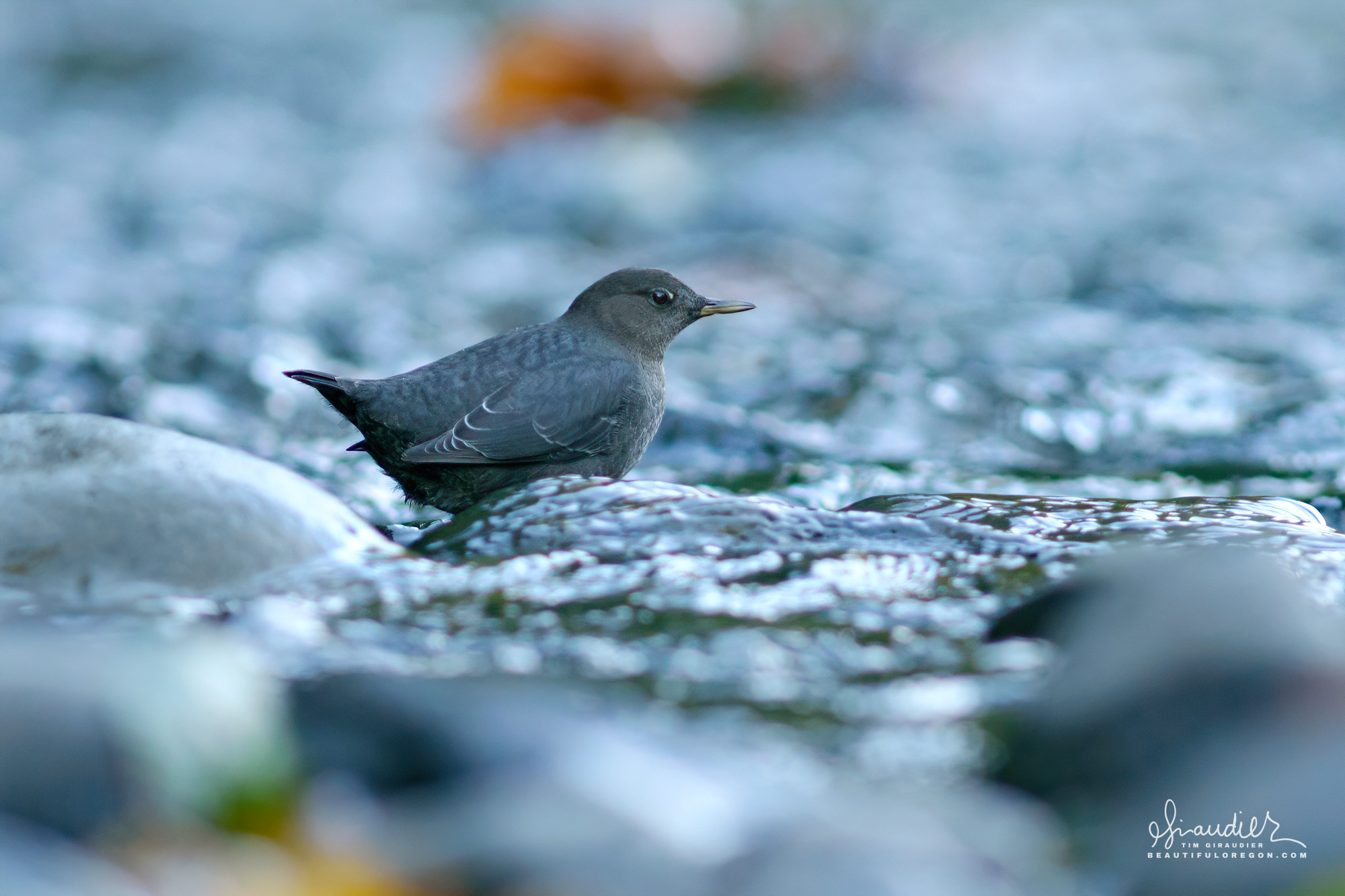
An American Dipper (Cinclus mexicanus) forages gravel beds in Eagle Creek for recently spawned salmon eggs. Multnomah County, Mount Hood National Forest, Columbia River Gorge, Oregon. If interested in blank greeting cards of this image, you can find them in my Note Card Gallery here. The American Dipper: Life Cycle, Habitat, and Ecological Niche Among the most distinctive riverine birds of western North America, the American Dipper (Cinclus mexicanus) holds a singular place in the ecology of mountain streams. Known for its bobbing movements and remarkable ability to forage underwater in swift currents, this small gray songbird is uniquely adapted to life in cold, turbulent rivers. Its presence is often taken as an indicator of clean, oxygen-rich water and a healthy aquatic ecosystem. Life Cycle The American Dipper is a resident species, remaining in or near its chosen river habitat year-round, even in winter when ice rims the streams it inhabits. Pairs typically establish breeding territories along stretches of river in early spring, often returning to the same territory in successive years. Courtship is relatively subtle, involving song exchanges, short aerial chases, and bowing displays. Nesting begins as early as March in lower elevations and later in higher mountain valleys as snowmelt recedes. The nest is a domed, mossy structure built near water, frequently on cliff ledges, under bridges, behind waterfalls, or in crevices where the constant spray keeps the moss moist. Females usually lay 3–5 white eggs, incubating them for about 16 days. The male contributes by feeding the female and later helping to provision the young. Both parents tirelessly deliver aquatic insects and small fish to the nestlings, which fledge at about 24 days of age. Fledglings often remain close to their natal stream, learning to feed independently while still relying on parental care for several weeks. Although some pairs may attempt a second brood in favorable conditions, the brevity of alpine summers often restricts them to one successful nesting per year. Individuals have been known to live up to eight years, though most do not survive so long given the hazards of their environment. Habitat and Feeding Behavior The American Dipper is almost exclusively associated with fast-flowing, rocky streams and rivers from Alaska and Canada south through the western United States into Central America. Elevationally, they range from coastal rivers near sea level to subalpine torrents above 10,000 feet. The constant requirement is clear, cold, and well-oxygenated water, conditions that sustain the aquatic insects and small vertebrates on which they depend. Feeding behavior is both distinctive and highly specialized. Dippers forage by walking along streambeds, swimming against the current, and even diving headfirst into rapids. To stay submerged, they rely on strong wings that double as underwater “flippers,” dense plumage that resists water penetration, and an unusually high hemoglobin concentration in their blood, allowing for extended dives without fatigue. Their eyelids contain a thin white membrane that protects the eyes and enhances underwater vision. Their diet is dominated by aquatic insect larvae, particularly mayflies, caddisflies, and stoneflies—species that themselves are sensitive to pollution and habitat degradation. They also consume small fish, fish eggs, and occasionally amphibians. In winter, when insect larvae are less accessible, dippers often expand their range downstream to find open water and alternative prey. Their opportunistic yet specialized feeding habits require constant movement along stream corridors, sometimes covering several miles in a day. Ecological Niche As the only aquatic songbird in North America, the American Dipper occupies a unique ecological niche. It sits at the confluence of terrestrial and aquatic food webs, serving both as predator of aquatic invertebrates and as prey for raptors such as hawks and owls. By preying on larval stages of aquatic insects, dippers help regulate populations that, if unchecked, could alter stream community dynamics. Conversely, their dependence on insect larvae ties their fate closely to water quality. Dippers are often described as “bioindicators,” because their abundance and breeding success correlate with clean, unpolluted streams. Declines in dipper populations frequently reflect broader ecological problems such as sedimentation, dam construction, or contamination from mining and agriculture. In this sense, they function as living sentinels of watershed health. Their nesting choices—often in precarious sites near rushing water—also shape the distribution of moss and other plants that take root on constantly damp surfaces, adding to the biodiversity of riparian zones. American Dipper, Eagle Creek
Related products
 High Camp at Opie Dilldock Pass $ 49.50
 Abert Rim – Lake Abert $ 49.50
 A Foggy Day at Waldo Lake $ 49.50